Tuesday, September 24, 2013

Look WHO Hooted His Way Into the MUSEBOX!


This is Larry perched at his desk.


Professor Watermelon,

WHO do those people on TV think they are? Have you seen the commercial - the one making fun of us owls. They say we aren't as wise as people think we are. Take a look at the commercial spreading this ridiculous rumor!


Those silly owls must be paid actors. TRAITORS!

Do you think your creative writers can set the record straight? Maybe if they write some stories about some truly remarkable owls, we can stop this video from going viral.

WHO-serely,

Larry


Dear Larry,

You have to admit that the commercial is pretty funny. And they didn't say that ALL owls aren't wise - just some. As for my creative writers, I think they would love to write stories about some EXTRAORDINARY owls. Let's see what (or WHO) they come up with.

Sincerely,

Professor Watermelon


Dear Creative Writers,

WHO can take Larry's challenge? If you write a story featuring an EXTRAORDINARY owl, you will earn $10 Melon Dollars per page instead of $5.

Here are some "What if" questions to get you started:

What if an owl was the president of a computer company? (Notice the picture of larry and the symbol behind him.)

What if you created a character named Owlbert Einstein?

Have a HOOT creating these stories!

With Imagination,

Professor Watermelon


Sunday, September 22, 2013

The WEEKLY MUSE: Crows


Professor Watermelon with his puppet friend, Otis the Crow!
 
I was walking around my neighborhood this weekend and saw one of the most beautiful crows perched on a fence. He bobbed his head up and down and made a low guttural caw-cawing sound. His feathers were shiny black, but with the autumn sun shining on them, a dark purple sparkled. I was mesmerized by this magical creature. I knew then and there that I had found our Weekly MUSE!

I went back to my writer’s studio and began researching this magnificent bird. Here is what I found:

Crows are not your ordinary “birdbrained” creature. In fact, crows are incredibly smart. Some researchers say that crows are as smart as chimpanzees and gorillas – a somewhat close relative to humans. WOW!
 
American Crow

And crows have developed quite a close relationship with humans. In most places around the world, if you can find us, you can find them. The same could be said for rats, but rats try to hide from us while crows will sometimes try to find us.

Just like humans, crows have problem solving skills. They will make tools from wire and sticks to retrieve food from a hole. They will also place nuts in the middle of the road and wait for a car to crack it open. Take a look at the video to see this for yourself.


Crows are also very social birds. They travel together, live in families, protect each other, and even mourn the deaths of fellow crows. And if you cross a crow and cause him/her danger, he/she will call for help. Within moments a mob of crows will come to the rescue. They will scold you and possibly dart down at you from the overhead trees.

Crows can also remember faces. If you have ever caused a crow harm, he/she will not forget you. The crow’s family will unlikely forget you as well – and they are unlikely to ever forgive you.

But the most amazing insight I have learned about crows is their ability for friendship. In this video you will see two natural born enemies show love and compassion for one another.

Doesn’t that video just make your hear all warm and fuzzy. SMILE!

If you would like to learn more about crows and their common characteristics, look here.

With this new knowledge, what kind of story could you write? Maybe these WHAT IF questions will help you get started.

WHAT IF your main character (a human) becomes best friends with a crow?

WHAT IF crows go someplace magical at night, and your main character follows them to this magical place?

WHAT IF your main character understood the language of crows? Would this unlock secret knowledge about the human race?

The possibilities are endless, and please leave your own what if questions in the comment section below. I’d love to see what you come up with.

So, grab a cup of hot cocoa, a pencil and a piece of paper, and let’s begin. With your imagination, we can go anywhere. I look forward to seeing where you take us.

With Imagination,

Professor Watermelon

The word of the day is “mourn”. Here is the definition: to feel or express sadness for the death or loss of someone or something.

Saturday, September 14, 2013

The WEEKLY MUSE: Cicadas

As many of you already know, I lived in Seattle for ten years. And for the most part, summer evenings were pretty quiet compared to those of Indianapolis.
I’m not talking about the sounds of people or cars or police sirens. I’m talking about the little, green monsters with wings that live in the trees. CICADAS!

For many, the sounds of cicadas are obnoxious and mind numbing, but for me it is music to my ears. When I hear the cicada’s whine, I remember that I am HOME. And that brings me comfort and happiness.
So, it looks like we have found our MUSE.

CICADAS!

There are two general types of cicadas: annual and periodical.

Annual cicadas perform their life cycle within two years. Periodical cicadas perform a 13 or 17 year life cycle, making them the longest living insects in the world.
Here is how their life cycles work: In the summer a female tears a slit into a tree limb with her beak. She deposits her eggs inside. When the eggs hatch the small nymphs resemble a termite or a grain of white rice. These little guys suck on the tree’s juices.

Eventually, the nymphs will fall to the ground and begin tunneling into the earth. Here, they will spend most of their lives. Underground they continue to suck the juices from trees – this time from their roots.
When the time is right, the nymphs will begin digging back to the surface. They crawl across the ground until they find a tree to climb. And once they have found a secure place, they begin the last stage of metamorphosis. They emerge from their exoskeleton and leave the shell behind.

I used to hunt for these exoskeletons when I was a kid, and I still do today! Take a look at the photo and see the latest beauties I found.

Three cicada exoskeletons found on a pine tree.
 
Once the cicada’s wings are dry and ready for flight, they begin searching for a mate. The males make their signature whining sound to swoon a female, and the life cycle starts all over again.

A cicada emerging from its exoskeleton.


The cicada I found was a “Dog Days” cicada. These cicadas are annual cicadas that are easy to find year after year.
Take a look at this video to see the amazing Magicicada! These cicadas emerge once every seventeen years.


As you just learned, cicadas come out in MASS numbers. But why?
Well, the cicada has many predators. For one, squirrels eat them like nuts. Birds, raccoons, opossums, foxes and even people eat cicadas, too.

But nothing compares to the infamous CICADA KILLING WASP. If you plan to write a story about a cicada, consider these bad boys as your antagonist. Take a look at this incredible video.


All I can say is, “WOW!”

By the way, did you hear all the cicada "chorus" in the background of that video?

Here is one last interesting fact about cicadas. They LOVE lawnmowers! Yup, the twirling blades sound like a cicada PARTY!
With this new knowledge, what kind of story could you write? Maybe these WHAT IF questions will help you get started.

WHAT IF your main character was a Cicada King? What if the Cicada King led an army of cicadas against a swarm of Cicada Killing Wasps?
WHAT IF your main character found the exoskeleton of a GIANT cicada? This GIANT cicada is the size of a school bus, and it is on the loose! 

WHAT IF your setting was underground and the 17 year cicadas were planning their trip to the surface? What would they be feeling? Would they be excited? Scared? Sad?
The possibilities are endless, and please leave your own WHAT IF questions in the comment section below. I’d love to see what you come up with.

So, grab a cup of hot cocoa, a pencil and a piece of paper, and let’s begin. With your imagination, we can go anywhere. I look forward to seeing where you take us.
With Imagination,

Professor Watermelon
The word of the week is “exoskeleton”. Here is the definition: the protective or supporting structure covering the outside of the body of many animals, such as the thick cuticle of arthropods.

Wednesday, August 21, 2013

Weekly MUSE: Milkweed


Every year around this time, I get the itch to go MILKWEED hunting. Why?
Well, it all began about twenty years ago. Mrs. Hughes, my sixth grade science teacher, took us to the nature center behind our elementary school. She told us that a magical plant lived there called MILKWEED.
“What is magical about milkweed,” I had asked. “Does it grow really tall or something?”
“It grows up to six feet tall,” said Mrs. Hughes. “But that’s not what makes it so magical.”
“Does it cure the chicken pox?” asked my friend, Eric.
“I don’t think so,” said Mrs. Hughes. “Although many years ago, pioneers thought it could cure warts.”
“Awesome,” said Brandon, sticking out his thumb. “I have a wart!”
Mrs. Hughes giggled.
Just then, a beautiful black and orange butterfly fluttered over our heads and flew toward the nature center.
“Follow that butterfly,” said Mrs. Hughes.
And we did. The butterfly led us right to a milkweed patch, and Mrs. Hughes shared all she knew about her magical plant.
Twenty years later, I am still fascinated by Mrs. Hughes’ magical plant, and I’m going to share its magic with you. Creative Writers, we’ve found our MUSE!
MILKWEED!
The milkweed plant found at the Holiday Park Nature Center in Indianapolis, IN.
Milkweed grows 2-6 feet tall in fields and roadsides east of the Rocky Mountains.
If you break off a leaf, you will quickly notice a milky substance that drips from the tear. This is what makes the milkweed so magical.
A milky substance seeps from the torn leaf of a milkweed plant.
For most animals, this milky substance is poisonous – but not for the beautiful Monarch butterfly.
The Monarch butterfly lays her eggs on the underside of the milkweed’s leaves. When the eggs hatch, tiny caterpillars begin munching away at the poisonous plant. The poisons are saved within the caterpillars’ bodies, making them poisonous too! BRILLIANT!
When the caterpillars transform into butterflies, they remain poisonous, and birds know it. The orange and black colorings send a clear warning signal. “If you EAT me, you will PUKE!”
Milkweed bugs are also black, orange, and POISINOUS! Maybe everything that eats milkweed will turn black, orange and poisonous. Please don’t try this at home.
A cluster of milkweed bugs bore into a seedpod.
While I was observing the milkweed garden, I saw so many fascinating events happening on one simple plant.
On the underside of a leaf, I found a ladybug larva eating aphids. Aphids are tiny insects that suck the juices from many different kinds of plants. Take a look at the photo to see this ladybug larva.
A ladybug larva searches for aphids. The small yellowish specks are aphids.
 
On the top of a leaf, I found an ant trying to chase away an adult ladybug. Why? Well, the ladybug eats aphids. And the ants guard the aphids because they make a tasty substance called honeydew. Ants “milk” the aphids to get this special treat.
An ant tries to run away an adult ladybug.
 
I also saw a spider, a daddy-long-leg and some other neat critters.
Here are a few more fun facts about milkweed:
Milkweed produces pink to lavender flowers in the summer. These flowers eventually become warty seedpods filled with downy fluff. The seeds are attached to this fluff and are carried off into the wind like parachutes.
This milkweed "fluff" is about to sail off into the wind.
A very long time ago this downy fluff was used by Native Americans to insulate their moccasins. And during World War II, school children collected 283,000 bags of milkweed fluff to be used in military lifejackets.
If you still need to be convinced that milkweed is magical, take a look at this short video.
 
None of that would have been possible without the MAGIC MILKWEED! 
With this new knowledge, what kind of story could you write? Maybe these WHAT IF questions will help you get started.
WHAT IF your story’s setting was one stalk of MILKWEED and the characters were ants, aphids, ladybugs, and Monarchs?
WHAT IF a rare MILKWEED plant was found that seeped blue milk instead of white? Does it have magical qualities?  
WHAT IF your main character was a Monarch caterpillar that hatched on the wrong plant? Will he/she go searching for MILKWEED? How will he/she find it?
The possibilities are endless, and please leave your own WHAT IF questions in the comment section below. I’d love to see what you come up with.
So, grab a cup of hot cocoa, a pencil and a piece of paper, and let’s begin. With your imagination, we can go anywhere. I look forward to seeing where you take us.
With Imagination,
Professor Watermelon
The word of the week is “larva”. Here is the definition: the immature, wingless, feeding stage of an insect that undergoes complete metamorphosis.


Monday, July 8, 2013

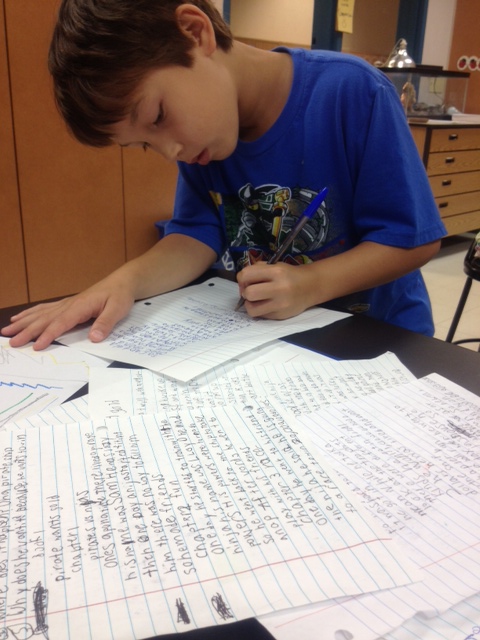
Creative Writing with Professor Watermelon at the Sycamore School

 
CREATIVE WRITING with PROFESSOR WATERMELON
at the SYCAMORE SCHOOL in INDIANAPOLIS


This Creative Writer has found his MUSE!


Creative Writing Challenge: Take a creature with a bad reputation (like spiders) and flip-flop it.
What if a tarantula was a brain surgeon?
What if a tarantula thought he was a teddy bear and just wanted to be cuddled?
What if a tarantula decorated cakes?


Learning how to write with all FIVE senses is very important.
We practiced writing the sense of TASTE by describing the taste of PICKLES!


Creative Writers touch a live LOBSTER!


Tuesday, May 28, 2013

Sunflowers


Photo by: Stig Nygaard
My grandfather’s sister taught me how to draw flowers. She also taught me how to appreciate flowers, even the flowers that most people call weeds – like dandelions and clover. I can still see her cupping a dandelion in her hand and saying, “Now, isn’t that just beautiful.”

Her name was Lilly, but all of us kids called her “Nanny.”

Nanny loved ALL flowers, but she did have a favorite, which would become my favorite flower, too.

The SUNFLOWER!
Nanny with a very young Professor Watermelon

Nanny believed that everyone with a yard should plant at least one sunflower a year. For most of my adult life, I have lived in an apartment, but I still buy sunflower seeds every year and give them to my students.

Creative Writers, we’ve found our MUSE! Let’s take a closer look at this garden majesty and see what we can learn.

Sunflowers grow very tall. Normally they reach 5 to 12 feet, but some grow even taller than that. According to the Guinness Book of World Records, the tallest recorded sunflower grew 27 feet. This giant was grown in Germany in 2012.

Sunflowers are an American plant. Native Americans harvested sunflowers thousands of years ago. Today, sunflowers are still harvested here in America. Take a look at this video and see how sunflowers are farmed in North Dakota.

While sunflowers may be native to the Americas, they are now grown all over the world. In fact, Russia grows more sunflowers than any other country. Maybe that is why the sunflower is Russia’s national flower.

As you noticed in the video, farmers grow sunflowers for their seeds. One sunflower head can produce over 2,000 seeds. These seeds are used mostly for making sunflower oil, but the rest are eaten by people and… BIRDS!

Take a look at this video of some birds nibbling away at some wild sunflower heads.

Sunflower seeds are also ground into delicious sun-butter. For those of you who are allergic to peanut butter, sun-butter is a tasty alterative.

Growing sunflowers are very easy. Just follow the directions on the back of the seed packet, and you will do just fine. If you would like to see a video on planting sunflowers, I have provided one for you below…

Sunflowers grow very quickly. And when they form a flower bud, watch how it follows the sun in the sky. This is called heliotropism. Once the bud blooms, the sunflower stops following the sun, leaving its blossom facing the East.
"Sunflower" by Professor Watermelon
Like I mentioned before, Nanny taught me how to draw all kinds of different flowers. This is something I still do to this day. Here is picture of a sunflower I drew this morning.

With that new knowledge, what kind of story could you write? Maybe these “what if” questions will help you get started.

WHAT IF Jack planted a magic sunflower seed instead of a magic bean?

WHAT IF found crop circles were found in Russia’s sunflower fields?

WHAT IF little elves built a city in your main character’s sunflower garden?

The possibilities are endless! And please leave your own “WHAT IF” questions in the comment section below. I’d love to see what you come up with.

Grab a cup of hot cocoa, a piece of paper and a pencil, and let’s begin. With your imagination, we can go anywhere! I look forward to seeing where you take us!

With Imagination,

Professor Watermelon

P.S. The word of the week is "Heliotropism". Here is the definition: The growth of plants or plant parts (especially flowers) in response to the stimulus of sunlight, so that they turn to face the sun.